Audio & Headphones · Buying guide
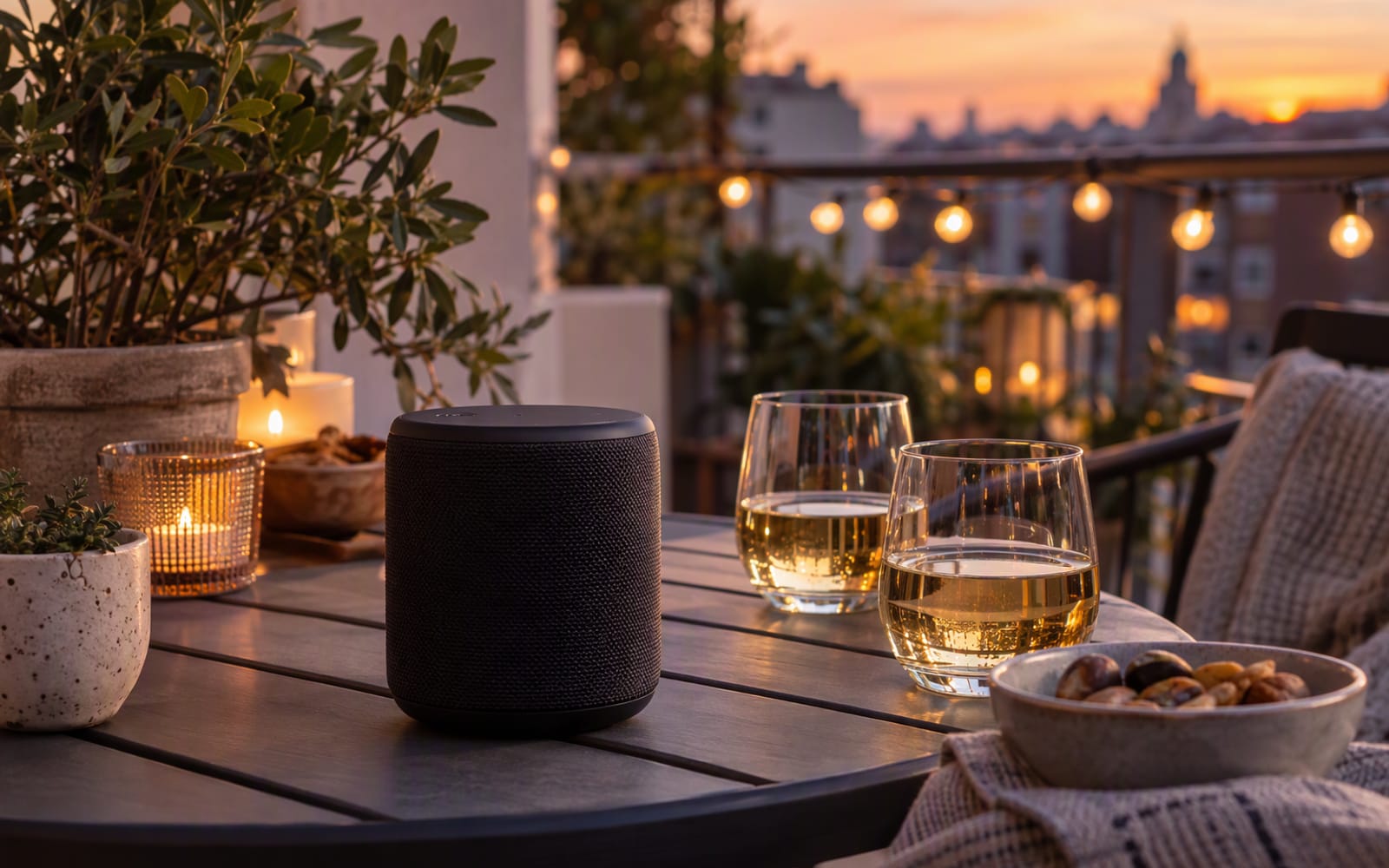
A balcony is a strange listening space. It is outdoors, so you want more output than a kitchen speaker. It is small, so you do not need a party system. And it is usually shared with neighbours, which means the limit on how loud you can go is not the speaker at all: it is the wall between you and the next flat.
Getting that balance right is the whole job, and it is why the biggest or loudest speaker is rarely the right answer here.
The real constraints
Two things shape the decision more than any specification:
- Neighbours and shared walls. A speaker that is pleasant at a moderate volume on an enclosed balcony is worth more than one that only sounds good when pushed. Distortion at high volume is also what travels through walls and irritates people.
- Weather. A balcony is exposed to rain, sun, dust and temperature swings. Water and dust resistance is not a nice extra here; it is the difference between a speaker that lasts and one that does not.
Everything else — bass, battery, features — is secondary to those two.
Size versus output, honestly
Portable speakers trade size against output, and the trade is not linear. A slightly larger speaker often produces noticeably more bass and headroom than a smaller one, but it also becomes heavier and less likely to leave the house. The best speaker for a balcony is usually the one you are happy to carry, not the one with the biggest published output.
For a small balcony and a handful of people, a compact speaker is plenty. You are not filling a field. You are filling a few square metres, and a speaker with clean output at moderate volume will sound better than a bigger one pushed hard.
Rule of thumb. If you can hold a normal conversation over the music, the volume is right for a shared building. If you cannot, you are not choosing a speaker — you are choosing a complaint.
Weather resistance
Water and dust ratings are expressed as an IP number: the first digit covers dust and the second covers water. For a balcony, look for a rating that covers both rain and dust rather than a token splash rating. The models below, based on published specifications, are rated for outdoor use, which is the baseline you want.
Two practical notes the ratings do not cover:
- Sun exposure degrades rubber and plastic over time. Leaving a speaker permanently on a sunny balcony shortens its life regardless of its rating. Bring it in when you are not using it.
- Cold reduces battery performance. A speaker left outside overnight in winter will not deliver its rated battery life the next morning.
Does it need to charge your phone?
Some speakers, including the JBL Charge 5, can output power over USB and top up a phone from their own battery. That is genuinely useful if you spend long days outdoors with music and a phone, and it is the main reason to accept the extra size.
If you never need it, it is weight you are carrying for nothing. Be honest about whether the feature matches your habits, and remember that using it drains the speaker faster, so you trade music time for phone charge.
Our picks
JBL Flip 6 — the default for a small balcony. Based on published specifications, it is loud enough for a small gathering, rugged enough to be left outside, and small enough that it actually gets taken places. It has no microphone, so it is not a speakerphone, and the bass rolls off when you push it hard, which is fine because pushing it hard is exactly what annoys the neighbours. For most people with a balcony, this is the sensible starting point.
Bose SoundLink Flex (2nd gen) — for outdoor use and packing. Its flat, wide profile makes it easier to pack than a cylinder and less likely to roll off a table. The sound, based on published specifications, is tuned for open air, and vocals stay clear at moderate volume, which suits podcasts as much as music. What you give up is bass, which is modest for the size, and it is not loud enough for a large gathering. For a balcony or a park, that is a reasonable trade.
JBL Charge 5 — for long days and phone charging. Bigger than the Flip, and the reason to choose it is the USB output that can top up a phone from its own battery, plus a long published battery rating. It is heavy for a day bag and its bass also rolls off when pushed, but if you want music and a charged phone through a long afternoon, the size buys you something real.
| What you prioritise | Best fit from this shortlist | What you give up |
|---|---|---|
| Small balcony, easy storage | JBL Flip 6 | No speakerphone; bass limited at high volume |
| Packing and outdoor durability | Bose SoundLink Flex (2nd gen) | Modest bass; not loud enough for a crowd |
| Phone charging on the go | JBL Charge 5 | Weight; battery drains faster when charging |
A portable speaker is not a hi-fi
It is worth saying plainly: a portable Bluetooth speaker is a compromise. It is small, it is battery powered, and it is built to survive being carried around. A speaker designed for a fixed position in a room will almost always sound better for the same money, because it does not have to make those sacrifices.
If your music mostly happens indoors, buy an indoor speaker. If it mostly happens on a balcony, in a garden or out with friends, a portable speaker is the right tool, and the compromises are the price of the portability you actually want.
What not to overpay for
- Very high published output. On a balcony shared with neighbours, you will never use it, and clean sound at a moderate volume matters more than maximum loudness.
- A large battery rating. Match the rating to your longest session, not to the biggest number available.
- Stereo pairing with a second speaker. Nice in principle, rarely used in practice. Do not let it drive the decision.
- Premium branding. A well-made mid-range speaker with good weather resistance will serve a balcony as well as a flagship model.
When not to buy anything
If you already own a speaker that survives being carried outside and sounds fine at a moderate volume, you do not need a new one. A balcony does not demand much from a speaker, and the upgrade from a working portable speaker to a marginally better one is small.
And if your neighbours are close and the walls are thin, the honest answer might be headphones rather than a speaker at all. That is not a compromise — it is the choice that keeps the peace and, often, sounds better anyway.
Prices in this category change frequently, so confirm the current figure with the merchant before deciding, and choose on features and weather resistance rather than the number on the page.
Our picks
These are the models we would shortlist for the scenarios in this article. Each entry shows the published specification highlights, what the product is genuinely good at, and what you give up.
JBL Flip 6
JBL
The bottle-shaped speaker that has become the default for a reason: it is loud enough for a small gathering, survives being left outside, and the size means it actually gets taken places.
What it does well
- Punchy for its size
- Genuinely rugged
- Easy to carry and store
What to accept
- No microphone for calls
- Bass rolls off at high volume
- Not a replacement for a proper indoor speaker
Best for: Balconies · Picnics · Small kitchens
Published specs: Portable Bluetooth speaker, cylindrical; Water and dust resistant for outdoor use; Published battery rating around 12 hours; PartyBoost pairing with other JBL speakers.
Last checked: 2026-09-18
Bose SoundLink Flex (2nd gen)
Bose
A flatter, wider speaker than the cylinder designs, which makes it easier to pack and less likely to roll off a table. It is built to be left outside, and the sound is tuned for open air rather than a small room.
What it does well
- Survives rain, sand and being dropped
- Flat shape packs easily into a bag
- Clear vocals for podcasts outdoors
What to accept
- Bass is modest for the size
- No microphone for calls
- Not loud enough for a large gathering
Best for: Balconies · Beach and park days · Cooking outdoors
Published specs: Portable Bluetooth speaker, flat profile; Waterproof and dust resistant for outdoor use; Published battery rating around 12 hours; Position-independent sound tuning.
Last checked: 2026-09-18
JBL Charge 5
JBL
Bigger than a Flip and, more usefully, it can charge your phone from its own battery. If you spend a day outdoors with music and a phone, that single feature justifies the extra size.
What it does well
- Can top up a phone from its own battery
- Loud enough for a garden
- Long published battery rating
What to accept
- Heavy for a day bag
- Bass rolls off when pushed hard
- Charging a phone drains it quickly
Best for: Camping · Garden parties · Charging a phone outdoors
Published specs: Portable Bluetooth speaker with USB output; Waterproof and dust resistant; Published battery rating around 20 hours; PartyBoost pairing with other JBL speakers.
Last checked: 2026-09-18
Frequently asked questions
How loud can I play music on a balcony?
The practical limit is not the speaker but your neighbours. As a rule of thumb, if you can hold a normal conversation over the music, the volume is reasonable for a shared building. A speaker with clean output at moderate volume suits this better than one that only sounds good when pushed.
Do I need a waterproof speaker for a balcony?
You want water and dust resistance if the speaker will be left outside, because rain and dust are the main threats. The rating matters for the case as much as the speaker, since it often sits out in the weather. Bring it indoors when you are not using it to extend its life.
Is a bigger Bluetooth speaker better for outdoors?
Not necessarily. A larger speaker usually produces more bass and headroom, but it is also heavier and less likely to be carried outside. For a small balcony and a few people, a compact speaker with clean output at moderate volume is often the better choice.
Can a Bluetooth speaker replace a hi-fi?
No. A portable speaker is small and battery powered, which are exactly the compromises that limit its sound. An indoor speaker designed for a fixed position will usually sound better for the same money. Choose a portable speaker for where it can go, not for how it compares with a hi-fi.
Related

Audio
Best Noise-Cancelling Headphones for Open-Plan Offices
Open-plan offices are the hardest listening environment there is. Here is how to choose noise-cancelling headphones for a shared desk, and which models we would shortlist.
Audio
Open-Back vs Closed-Back Headphones: Which Should You Buy?
The single biggest decision in headphone buying is not the brand or the price. It is whether the cups are open or closed. Here is how the choice changes everything.

Audio
Wireless Earbuds for Running: What Actually Stays In Your Ears
Fit and retention decide whether running earbuds survive a 5K, not sound quality. How to choose for your ear shape, sweat, and traffic awareness.